
Impulse and room
A log sweep impulse, distortion from the same sweep, EDT, T20 and T30 per octave, C50 and C80.
Inside Align: Impulse
How to use it
- 1
Connect
Connect the interface, with the microphone where you want to read the room.
- 2
Sweep
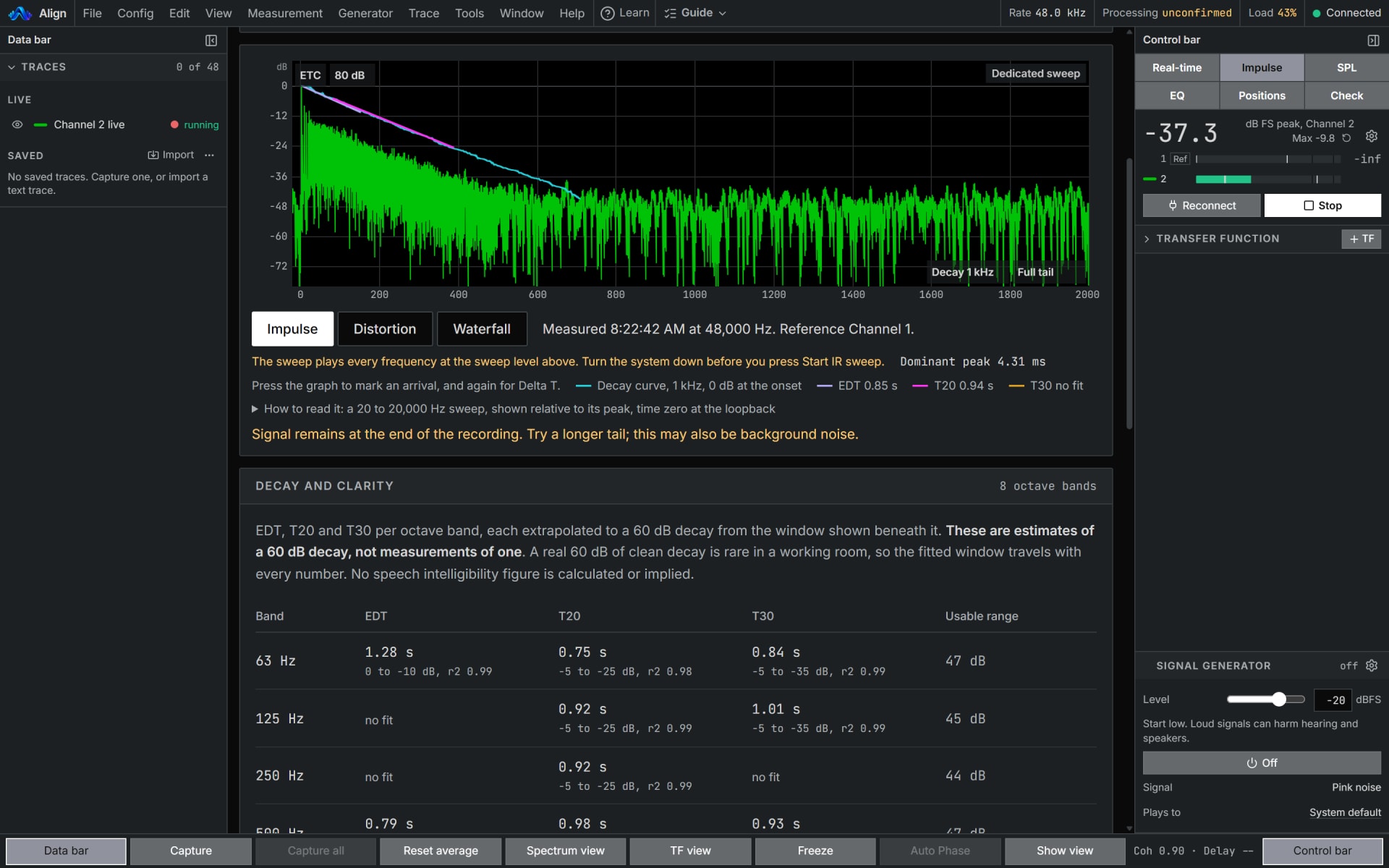
Press Start IR sweep: a log sweep plays through the system and its impulse response is drawn.
- 3
Read the room
EDT, T20 and T30 per octave, C50 and C80, and the distortion read from the same sweep.
How Align works it out
What it computes and how, each line read off the code the tool runs.
The recording is divided by the sweep that was sent, frequency by frequency, with a small numerical floor under the division, and transformed back to time: that is the impulse response.
For each octave from 63 Hz to 8 kHz the response is band-limited and its squared energy is added up backwards from where the decay meets the noise. A straight line is fitted to that curve, and its slope is stated as the time for a 60 dB fall.
Reference: Schroeder, 1965, the backward integration. ISO 3382-1:2009, 5.3.3, and Lundeby and others, Acustica 81, 1995, where it starts. Named as sources, not as a claim of compliance.
EDT is fitted from 0 to -10 dB, T20 from -5 to -25 dB and T30 from -5 to -35 dB. A time is given only where the lower end of its fit stands 10 dB over the noise.
C50 and C80 are 10 log10 of the energy in the first 50 or 80 ms after the direct sound over the energy after it. Distortion reads each harmonic from its own impulse, which a log sweep puts ahead of the main one.
Reference: ISO 3382-1, the 50 and 80 ms limits. Farina, AES 2000, distortion from a log sweep. Named as sources, not as a claim of compliance.
What you need
- Chrome or Edge on a computer, to measure live
- An audio interface and a measurement microphone
- Pro
Learn it
Training teaches the measurement from the rig up, free to read with no account.
Lesson 5, Read itQuestions
- What do T20 and T30 mean?
- Reverberation time, read from 20 or 30 dB of the decay and stated as the time for a 60 dB fall.
- What if the room is noisy?
- Each band's decay is read down to where it meets the noise. Where there is too little range above the noise for T30, it is not given.
- Why a dedicated sweep?
- The impulse comes from its own sweep, never from the live transfer function, so the decay and the distortion are read from one clean run.